UK Horse Racing Betting Strategy: A Data-Driven Guide for Serious Punters
 Available in US
Table of Contents
- The Five Numbers That Should Shape Every Bet You Place
- The UK Horse Racing Betting Market in Numbers
- How UK Horse Racing Odds Work
- Value Betting: Finding the Edge in Every Market
- Form Analysis: Reading the Racecard Like a Professional
- Each-Way Betting and the 80/20 Approach
- Betting Exchanges vs Bookmakers
- Bankroll Management: Protecting Your Betting Capital
- How UK Regulation Shapes Your Betting Strategy
- Choosing the Right Strategy for Your Profile
- Responsible Gambling and Long-Term Sustainability
- Frequently Asked Questions
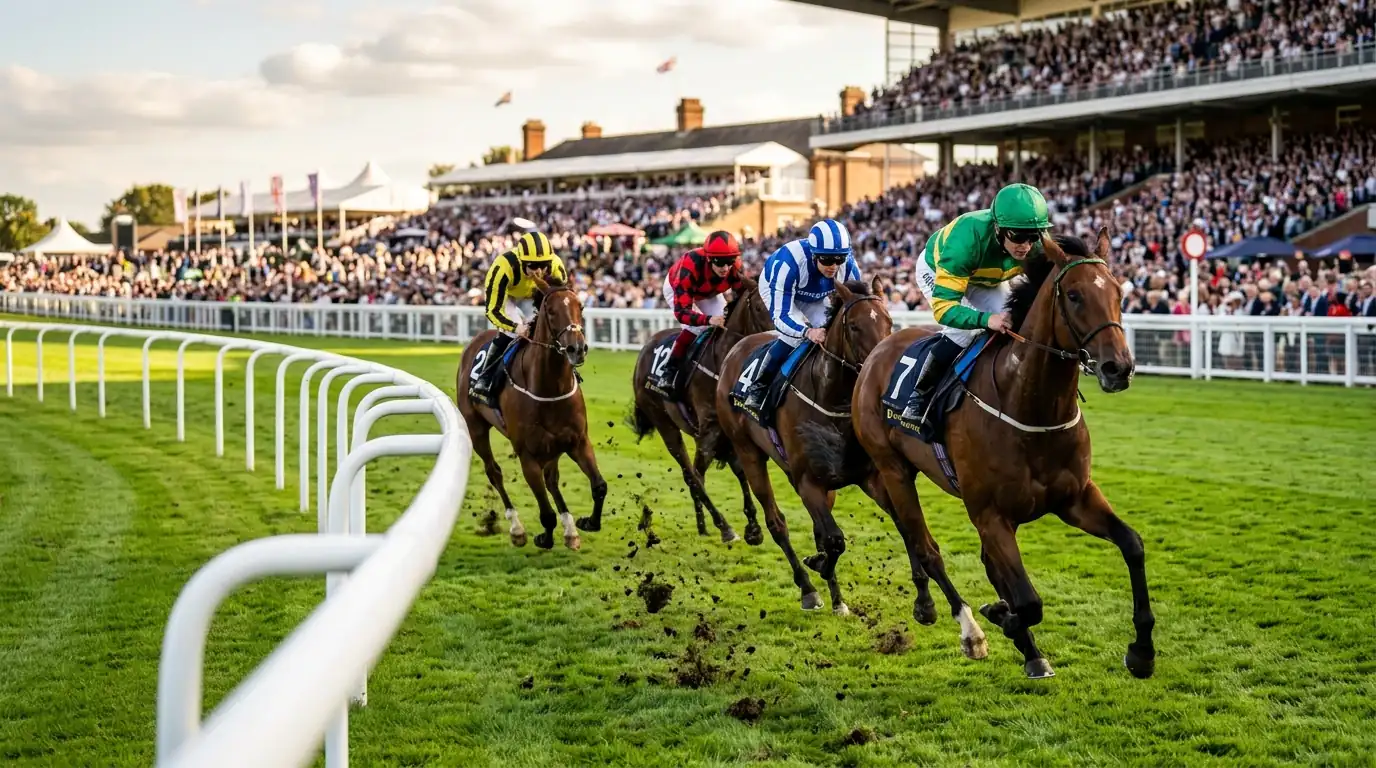
Nine years ago I placed what I thought was a clever bet on a well-fancied runner at Newbury. I had done no form analysis, ignored the going change that morning, and picked my horse because a colleague mentioned its name at lunch. It lost by twelve lengths. That afternoon cost me forty quid and taught me something worth far more: gut feeling is not a strategy.
Since then I have spent the better part of a decade building, testing, and refining data-driven approaches to UK horse racing betting. I have tracked thousands of bets, watched ROI lines crawl upward over months and crater over bad weekends. Profitable punting is not about picking winners — it is about finding value, managing risk, and understanding the market you are operating in.
Horse racing generates GGY of 766.7 million pounds through remote betting alone, making it the second-largest sport by revenue in the country. The industry contributes an estimated 4.1 billion pounds to the UK economy annually across 59 racecourses. This is a market with depth, liquidity, and — critically for us — enough inefficiency to exploit if you know where to look.
This guide is a structured, data-backed framework covering every layer of serious horse racing betting: how the market works, where value hides, how to read form systematically, when to use exchanges over bookmakers, how to size your stakes without blowing up, and how regulation is reshaping the landscape right now. Every claim is grounded in official data from the Gambling Commission, the BHA Racing Report, the Horserace Betting Levy Board, and academic research — sources that none of the top-ranking guides in this space bother to cite.
Whether you are moving beyond casual flutter territory or looking to sharpen a method that already has some structure, this is the reference I wish I had found nine years ago.
The Five Numbers That Should Shape Every Bet You Place
- Favourites win 30-35% of UK races but backing them blindly returns roughly 93% — a steady 7% loss. Your strategy must overcome the overround, not just pick winners.
- The top 1% of bettors generate 52% of all horse racing betting revenue. Consistency and volume, not occasional big wins, separate profitable punters from the rest.
- Exchange odds on outsiders can be substantially higher than bookmaker prices. Checking both platforms before every bet is one of the simplest edges available.
- Remote Gaming Duty rises from 21% to 40% in April 2026, threatening promotional offers like Best Odds Guaranteed. Build your strategy on fundamentals, not promotions.
- A minimum 100-unit bankroll, stakes capped at 1-3% per bet, and a stop-loss at 40% drawdown — these are not suggestions, they are survival requirements.
The UK Horse Racing Betting Market in Numbers
I meet punters all the time who treat horse racing like it exists in a vacuum — pick a horse, place a bet, hope for the best. They never think about the market they are actually competing in. That is a mistake. Understanding the size, structure, and direction of UK racing betting is the first step toward understanding why certain strategies work and others are doomed from the start.
Let me give you the picture. Of the 2.6 billion pounds in GGY that remote sports betting generated in 2024-2025, football took 1.3 billion and horse racing 766.7 million. Racing is not the biggest sport on the betting slip, but it is the one where individual market analysis can still give a punter a genuine edge. Football prices are hammered into efficiency by millions of global bets. Horse racing markets — especially lower-grade handicaps on a wet Tuesday at Southwell — still leave room for the prepared.
The scale of UK racing — British horse racing is the second-largest spectator sport in the country by attendance, employment, and revenue. In 2025, racecourse attendance hit 5.031 million — the first time it topped five million since 2019 — with average attendance per fixture rising 3.6% to 3,526. Prize money reached a record 194.7 million pounds. This is not a declining sport at the track; it is growing.

But here is the tension that every serious bettor needs to understand: while attendance is climbing, overall betting turnover on British horse racing fell 4.3% in 2025 compared to 2024, and 10.7% compared to 2023. The average turnover per race dropped 5.6% year-on-year. People are going to the races in bigger numbers but betting less on them. That is not a contradiction — it reflects regulatory pressure, affordability checks, and a migration of some punters to unlicensed operators that I will cover later in this guide.
Alan Delmonte, Chief Executive of the Horserace Betting Levy Board, captured this paradox when he noted that levy income had risen for a fourth consecutive period to a record 108.9 million pounds — the highest since the 2017 reform — even as betting turnover continued to fall. How? The levy is calculated on gross profits, not turnover. Bookmaker margins have widened. The same amount of money churning through the market generates more profit for the house. As a bettor, that should sharpen your attention. The market is getting harder, not easier, to beat.
The top 1% of horse racing bettors — roughly 60,000 individuals — generate 52% of all revenue from horse racing betting. If you are reading a guide like this, you are already thinking more seriously than the vast majority of the market.
One more number to keep in mind. Participation in horse racing betting over any four-week period sits at roughly 4% of the UK adult population, down from a seasonal peak of 7% during the summer festival months. That swing tells you something important about timing: the market gets thicker and more efficient during Cheltenham, Royal Ascot, and the Grand National period, and thinner — potentially offering more value — during the quieter months.
The market context matters because every strategy in this guide operates within these forces: shrinking turnover, widening margins, tightening regulation. Now let me show you how odds actually work — and where the bookmaker’s profit hides inside every price.
How UK Horse Racing Odds Work
A few years into my betting journey, I realised I had been reading odds without truly understanding what they represented. I knew that 5/1 meant “five pounds profit for every one pound staked.” What I did not know — and what changed everything — was that odds are not predictions. They are prices. And like any price in any market, they can be wrong.
UK horse racing traditionally uses fractional odds. When you see 4/1, you receive four pounds profit plus your one pound stake back — five pounds total — for every pound wagered. At 11/4, the return is 11 pounds profit for every 4 staked, or 2.75 pounds per pound. Decimal odds, increasingly common on exchanges and international platforms, express the total return including your stake: 4/1 fractional equals 5.0 decimal, and 11/4 equals 3.75.
| Fractional | Decimal | Stake | Profit if wins | Total return |
|---|---|---|---|---|
| 2/1 | 3.0 | 10.00 | 20.00 | 30.00 |
| 5/2 | 3.5 | 10.00 | 25.00 | 35.00 |
| 7/1 | 8.0 | 10.00 | 70.00 | 80.00 |
| 1/3 | 1.33 | 10.00 | 3.33 | 13.33 |
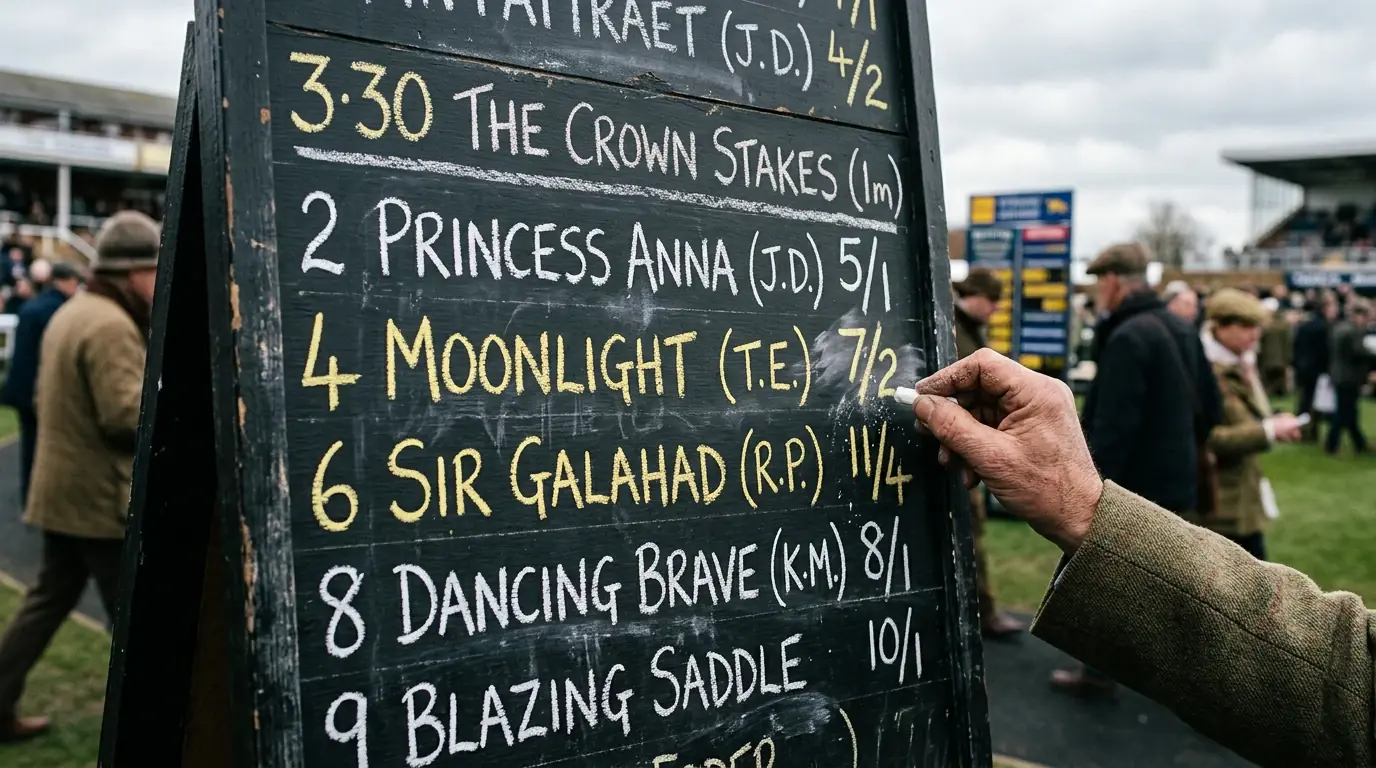
The conversion is simple. For fractional odds of A/B, the decimal equivalent is (A/B) + 1. For 5/2, that is 2.5 + 1 = 3.5. Going the other way, subtract one from the decimal and express as a fraction. These are not just cosmetic differences — decimal odds make it far easier to compare prices across bookmakers and exchanges at speed, which matters when a market is moving.
Implied probability — the chance of an outcome that the odds suggest. Calculated as 1 divided by the decimal odds, then multiplied by 100 to get a percentage. At decimal odds of 4.0, the implied probability is 25%. At 2.0, it is 50%.
Here is where it gets interesting — and where most casual punters lose without knowing why. If you add up the implied probabilities of every runner in a race, the total will exceed 100%. That excess is the overround, sometimes called the vig or the juice. It is the bookmaker’s built-in margin. A typical UK horse racing market carries an overround between 115% and 130%. In a six-runner race with an overround of 120%, you are effectively paying a 20% premium for the privilege of betting. In a twenty-runner handicap, the overround can be even steeper.
Favourites win roughly 30% to 35% of all UK horse races. In handicaps — where the weights are designed to equalise the field — that figure drops to around 25.7%. In novice races, where the form is less exposed, favourites win closer to 33%. Those baseline numbers are the foundation of every strategy in this guide, and I will return to them repeatedly.
Overround — the percentage by which the sum of all implied probabilities in a market exceeds 100%. An overround of 120% means the bookmaker has a theoretical 20% margin built into the prices.
The practical takeaway is this: you are not just trying to pick winners. You are trying to find horses whose true probability of winning exceeds the implied probability embedded in their odds. That gap — between what the market says and what the data says — is where profit lives. And measuring it requires understanding both odds formats fluently.
Favourite Win Rates: What the Data Shows
Every punter has heard some version of “back the favourite — they win a third of all races.” It is one of those statements that is roughly true and completely useless at the same time. The number itself is real: favourites win between 30% and 35% of UK races across all codes. But that average hides enormous variation depending on race type, field size, and class.
Favourite win rates by race type
Odds-on favourites — those priced below even money — win approximately 59% of the time on the flat turf, according to analysis of multi-year UK data. That sounds like a licence to print money until you realise that at those short prices, even a 59% strike rate can produce a negative ROI.
Second favourites win roughly 20% of races. Third favourites land around 12% to 15%. Combined, the top three in the betting account for 65% to 70% of all race winners. That leaves 30% to 35% of races won by something outside the top three — and those are the races where the biggest payoffs sit.
Now here is the number that matters more than strike rate: the return on investment. If you back every single favourite at starting price across a large sample — thousands of races — your ROI lands at roughly 93%. You lose about 7p in every pound. Back every second favourite and you lose about 12p. Third favourites: 15p. The further you go down the market, the steeper the loss — with one critical exception that creates the favourite-longshot bias, which I will touch on in the value betting section.
What a 93% ROI on favourites actually means
Suppose you place 1,000 bets of 10 pounds each on the favourite in every race. Total outlay: 10,000 pounds. At a 93% ROI, your total returns are 9,300 pounds. Net loss: 700 pounds over 1,000 bets, or 70 pence per bet. That 7% leak is the overround and the price of market inefficiency — and it is the gap a serious strategy must overcome.
These numbers are not discouraging. They are clarifying. They tell you that blindly backing favourites is a slow bleed, not a catastrophe. They also tell you that if you can identify the subset of favourites that win more often than the market implies — or the subset of longer-priced runners whose true chance is underestimated — you can tilt that ROI above 100%. That is the entire game.
Value Betting: Finding the Edge in Every Market
Strategy type
Analytical, price-driven
Skill level
Intermediate to advanced
Best suited for
All race types, especially handicaps and larger fields
Key requirement
Ability to estimate true probabilities independently of the market
The moment that shifted my betting from a hobby to something resembling a discipline was when I stopped asking “will this horse win?” and started asking “is this horse’s price too big?” Those are fundamentally different questions. The first one tries to predict the future. The second one tries to identify a mispriced asset. Value betting is the latter — and it is the foundation of every profitable approach I have used or encountered in nine years.
George E. Smith — known as “Pittsburg Phil” and widely regarded as one of the most successful professional horseplayers in history — said it plainly: you cannot be a successful horse player if you are going to get the worst of the price all the time. That was true in the 1890s and it is true now. The market has changed, the tools are better, and the data is richer, but the principle is identical. You need to be on the right side of the price.
The mechanics are straightforward. Every set of odds implies a probability. If a horse is priced at 4/1 (5.0 decimal), the market is saying it has a 20% chance of winning. If your analysis — based on form, conditions, trainer patterns, whatever framework you use — suggests that horse actually has a 28% chance, the bet has positive expected value. Over enough repetitions, positive expected value bets generate profit.
Calculating expected value on a single bet
You estimate a horse’s true win probability at 28%. The bookmaker offers 4/1 (decimal 5.0), implying 20%. Your edge is 28% minus 20% = 8 percentage points.
Expected value per pound staked: (0.28 x 4.00) – (0.72 x 1.00) = 1.12 – 0.72 = +0.40. For every pound you stake on this type of bet repeatedly, you expect to make 40 pence in the long run.
The “long run” is key. A single bet at 4/1 will lose 72% of the time. You need volume and discipline.
The hard part is not the formula. It is estimating the true probability accurately enough, often enough, to maintain an edge after the overround. That requires systematic form analysis, an understanding of market biases like the favourite-longshot bias, and ideally some method of building your own tissue prices before you look at the market.
I will not pretend this is easy. But the structure is clear, the maths is tractable, and the data is available. Value betting in horse racing is where I recommend every serious punter begins their strategic education — it is the lens through which every other strategy in this guide should be viewed.
Form Analysis: Reading the Racecard Like a Professional
I used to stare at racecards the way most people stare at a restaurant menu in a foreign country — I could see the information but I could not make it mean anything. The string of numbers and letters next to a horse’s name looked like noise. It took me the better part of two seasons to realise that racecard data is not noise. It is a compressed biography of every horse in the race, and learning to read it fluently is the single most practical skill a punter can develop.
What a form line contains — the sequence of digits next to a horse’s name records its finishing positions in recent starts, reading left to right from most recent. A “1” is a win, “0” means finished tenth or worse, “F” is a fall, “U” is unseated rider, “P” is pulled up, and a dash separates different seasons. The line 312-04 tells you the horse won two starts ago last season, finished third the start before that, ran first the time before, and this season finished fourth most recently after being out of the placings.
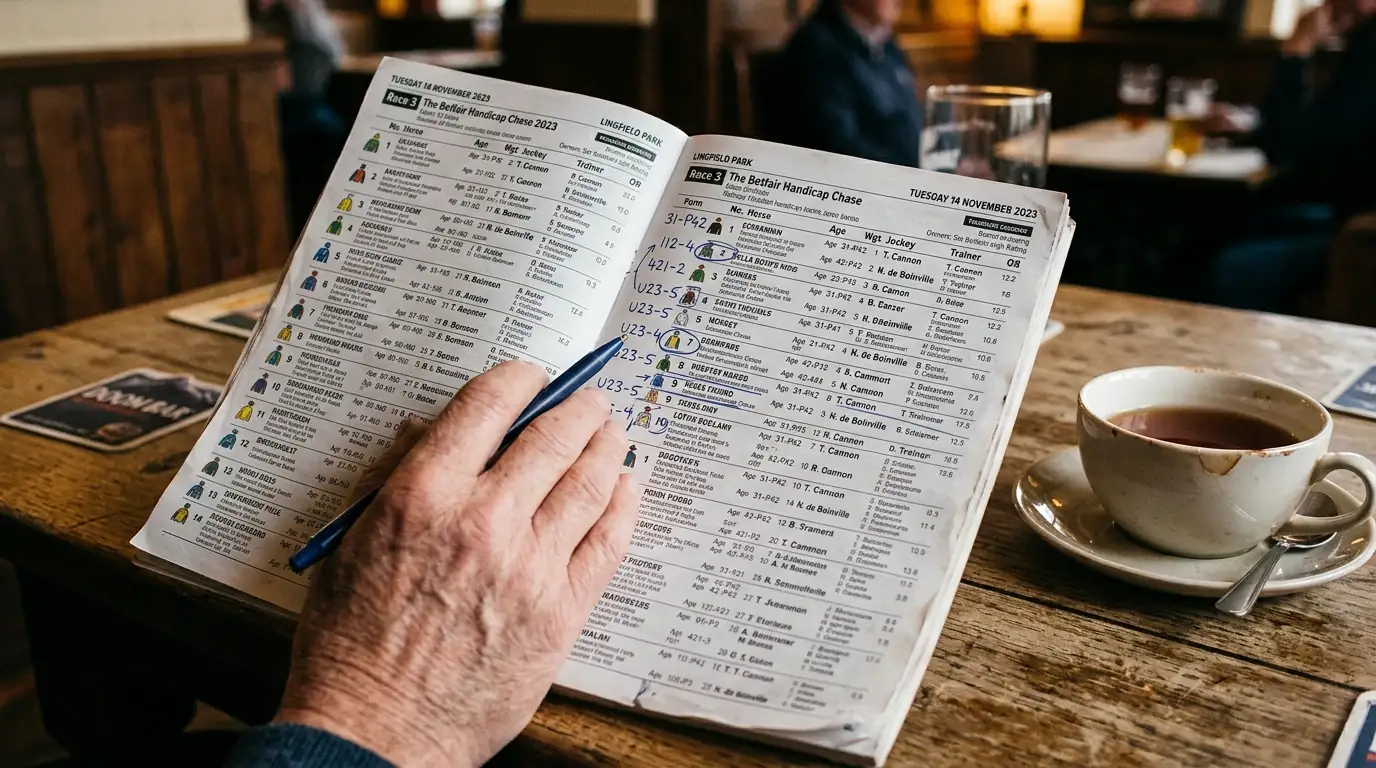
Form figures are just the starting point. Serious form analysis involves layering multiple factors: recent finishing positions, going preferences, distance suitability, course form, class level, the trainer’s current strike rate, the jockey booking, weight carried, and how the horse has performed under similar conditions before. Each of these dimensions filters out noise and narrows the field toward runners with a genuine chance.
The going — the state of the ground — is one of the most underrated factors in casual analysis. Some horses are transformed on soft ground and hopeless on firm. Others need fast ground to show their best speed. A going change between declaration time and race day can flip the form picture entirely. In 2025, 87.6% of UK races started within two minutes of their scheduled time, a significant improvement from previous years, which means going data is being reported more accurately and reliably than ever.
Going — the official description of ground conditions, ranging from firm (fast, dry) through good, good to soft, soft, and heavy (waterlogged). All-weather surfaces use standard, slow, or fast. The going is measured using a GoingStick, a mechanical probe that provides a numerical reading of moisture and penetration.
I could write a chapter on each form factor — and in fact the cluster article on horse racing form analysis does exactly that. For the purposes of this pillar guide, the principle is this: form analysis is not about finding the “best” horse. It is about finding horses whose recent form, under conditions similar to today’s race, is stronger than the market has priced in. That brings us back to value. Every tool serves the same master.
Each-Way Betting and the 80/20 Approach
There was a period early on when I ignored each-way betting completely. I thought it was a concession — a way of hedging your conviction, a sign that you were not confident enough to back a horse to win. I was wrong. Each-way is not a half-measure. In the right conditions, it is a strategy that generates consistent returns precisely because the place portion of the bet can carry positive expected value independently of the win part.
An each-way bet is two bets in one: a win bet and a place bet, at equal stakes. If your horse wins, both parts pay out. If it finishes in a place position (typically the top two, three, four, or five depending on field size and the bookmaker’s terms), only the place part pays — at a fraction of the win odds, usually one-quarter or one-fifth. Because you are staking twice your unit, a ten-pound each-way bet costs twenty pounds total.
| Scenario | Win odds | Place terms | Stake (E/W) | Total cost | Return if wins | Return if places only |
|---|---|---|---|---|---|---|
| 10-runner handicap | 10/1 | 1/4 odds, 3 places | 10.00 | 20.00 | 135.00 | 35.00 |
| 16+ runner handicap | 10/1 | 1/4 odds, 4 places | 10.00 | 20.00 | 135.00 | 35.00 |
The 80/20 approach is a framework I picked up early and still use. The idea is that roughly 80% of the value in an each-way bet comes from the place portion, particularly on longer-priced runners. When a horse is priced at 10/1 or longer in a large-field handicap with four or more place positions, the place part of the each-way bet can represent positive expected value even if the win part does not. You are effectively getting paid at 2.5/1 (one-quarter of 10/1) for a horse to finish in the top four of a sixteen-runner race. If that horse has a genuine 30% or better chance of placing, the maths works in your favour.
Second favourites win about 20% of races and third favourites around 12% to 15%, but their place rates are significantly higher. In big-field handicaps — the bread and butter of each-way punting — the top three in the betting finish in a place position far more often than the win-only ROI would suggest. That is where the edge sits.
Each-way betting rewards patience and large fields. It punishes small-field races where the place terms shrink to just two positions and the place odds barely cover your combined stake. I cover the mechanics, the maths, and the field-size triggers in detail in the dedicated guide to each-way betting strategy. For now, understand this: each-way is not a consolation prize. It is a structured way to extract value from the place market, and in certain race types it is the most efficient strategy available.
Betting Exchanges vs Bookmakers
The first time I placed a lay bet on an exchange, it felt like stepping behind the counter. For years I had only ever backed horses — put money on something to win. Laying a horse, betting that it would lose, was a conceptual shift that opened up an entirely different set of strategies. It also gave me access to consistently better prices, and that difference compounds over hundreds of bets into serious money.
| Feature | Traditional bookmaker | Betting exchange |
|---|---|---|
| Who sets the odds | The bookmaker’s trading team | Other bettors in the market |
| Overround | Typically 115%-130% | Typically 101%-105% |
| Can you lay (bet against)? | No | Yes |
| Commission | Built into the price | Charged on net winnings (typically 2%-5%) |
| Best use case | Each-way, BOG, promotions | Value bets, trading, laying |
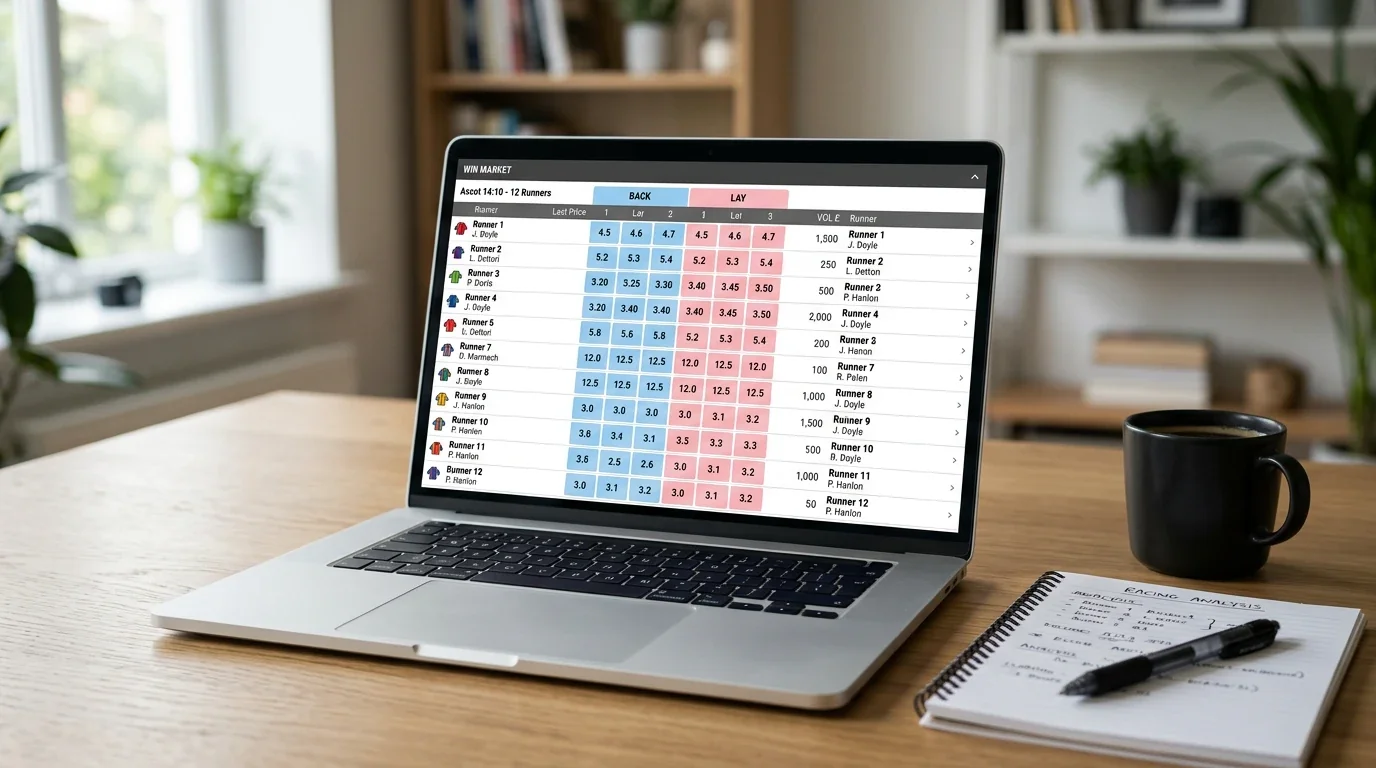
The practical difference shows up in the prices. Exchange odds on outsiders can be substantially higher than bookmaker odds because there is no overround inflating the market. On a 10/1 shot, the difference between exchange and bookmaker pricing can turn a 130-pound return into 200 pounds on the same ten-pound stake. Over a season, that gap compounds enormously. The exchange takes its cut as commission on your winnings rather than embedding it in every price.
Exchange markets for standard UK racing are liquid enough to use as a primary platform. Research on exchange dynamics shows new bets appearing roughly every fifty seconds in active markets, with an average of nearly ten participants. Liquidity thins for smaller meetings and evening cards, but afternoon action is well-served.
Exchanges also enable trading — backing a horse at a higher price and laying it at a lower price (or vice versa) to lock in a profit regardless of the result. This is the domain of back-to-lay strategies, scalping, and in-running trading. These are more advanced approaches that I cover in the dedicated exchange horse racing guide, but even if you never trade a market, using an exchange for straightforward win bets at better odds is one of the simplest edges available.
That said, exchanges are not always the best option. Best Odds Guaranteed offers from traditional bookmakers can outperform exchange prices when a horse steams in the market. Each-way terms offer place value that exchanges do not replicate directly. The smart approach is to use both, comparing prices before every bet and choosing whichever offers the better deal. That single habit is worth more than most “systems” you will find for sale online.
Bankroll Management: Protecting Your Betting Capital
I know a punter who had a genuine edge — a system that returned 108% ROI over 400 bets across a flat season. Impressive. He blew through his entire bankroll in six weeks. Not because the system stopped working, but because he staked 15% of his bank on each bet, hit an inevitable losing run of eleven consecutive losers, and had nothing left to bet with when the winners started coming again. The system was profitable. The staking was suicidal.
Profitable betting is a marathon, not a sprint — it requires discipline, patience, and proper bankroll management. That is not a platitude. It is the single sentence that separates punters who survive from those who do not.
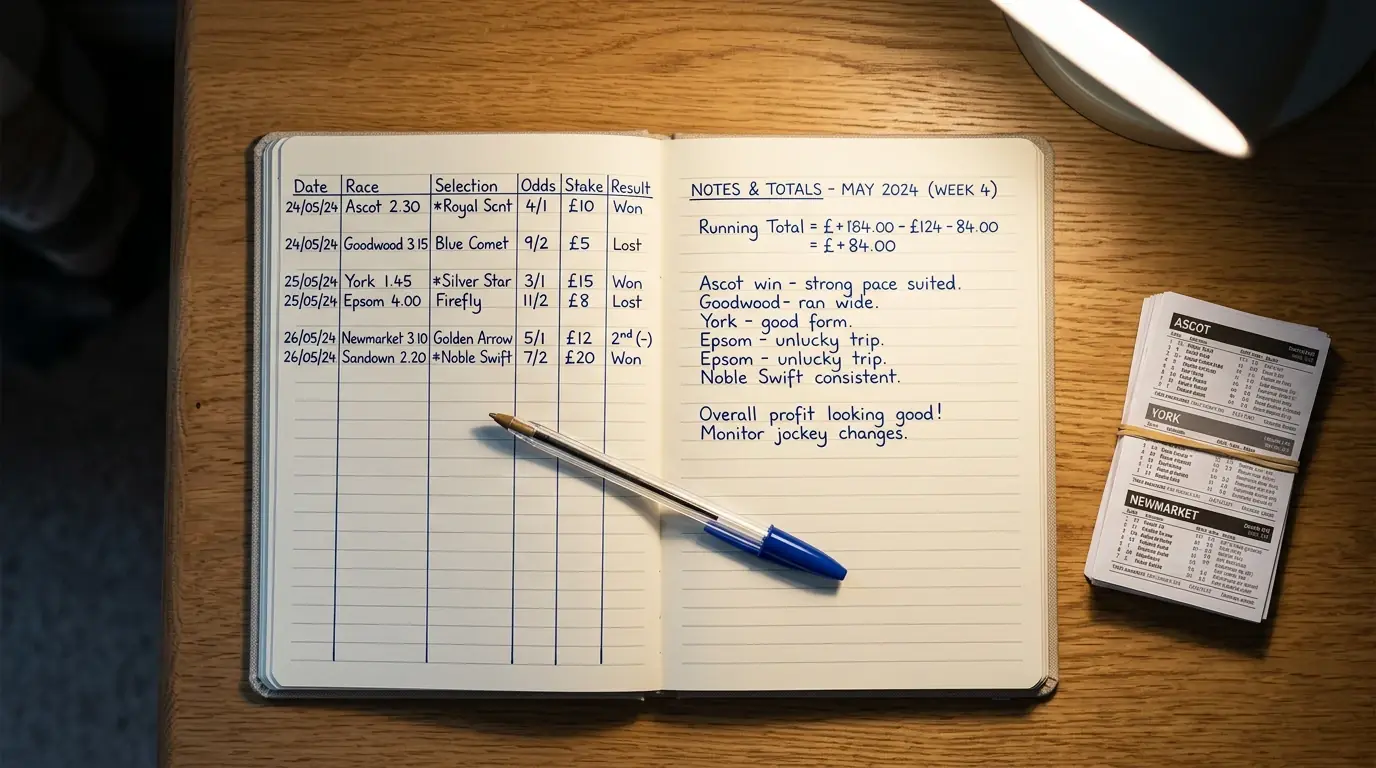
Your bankroll is a finite resource. It is the tool you use to exploit your edge, and if you destroy it through oversizing, you have no tool left. The minimum starting bankroll I recommend for anyone taking a structured approach to horse racing betting is 100 units — where one unit is your standard bet size. If you are comfortable risking ten pounds per bet, your starting bank is one thousand pounds. That gives you enough runway to survive the drawdowns that any method will produce.
The simplest staking approach is level stakes — the same fixed amount on every bet. It is transparent, easy to track, and protects against emotional escalation. The more mathematically rigorous approach is the Kelly Criterion, a formula that calculates the optimal stake as a function of your edge and the odds. Full Kelly is too aggressive for most punters — it produces wild swings — so the standard practice is fractional Kelly, typically staking one-quarter or one-half of the recommended Kelly amount.
Do
- Set a fixed bankroll that you can afford to lose entirely without affecting your life.
- Stake between 1% and 3% of your current bank on any single bet.
- Track every bet — stake, odds, result, running P&L — in a spreadsheet or journal.
- Set a stop-loss threshold (I use 40% drawdown from peak) where you pause and review your method before continuing.
Don’t
- Chase losses by doubling your stakes after a bad day.
- Stake more than 5% of your bank on any single selection, regardless of confidence.
- Treat winnings as “free money” that can be staked more aggressively.
- Mix your betting bankroll with your personal finances.
I have written extensively about the Kelly Criterion, fractional Kelly, drawdown mathematics, and stop-loss rules in the dedicated guide to horse racing bankroll management. If you read only one cluster article from this guide, make it that one. Every percentage point of edge you identify through form analysis or value betting is worthless if your staking plan does not give it room to express itself over a large enough sample. The edge is the engine. The bankroll is the fuel. Run out of fuel and the engine is irrelevant.
How UK Regulation Shapes Your Betting Strategy
Most betting guides treat regulation as background noise — something for lawyers and compliance officers to worry about. I used to think the same way. Then I watched the regulatory environment reshape the market so fundamentally over the past three years that ignoring it became impossible. If you are betting on UK horse racing in 2026, regulation is not context. It is a direct input into your strategy.
Start with the headline numbers. Unique visits to 22 unlicensed horse racing betting sites surged by 522% over four years between 2021 and 2024. More than 600,000 unique monthly visits were flowing to illegal operators by the end of that period. Meanwhile, visits to licensed legal operators grew by just 49% over the same window. Brant Dunshea, then Acting Chief Executive of the BHA, pointed out that from the beginning of the Gambling Act review, racing had warned about the unintended consequences of well-meaning policy decisions on the sport — and that the threat of inadvertently growing illegal market activity had become reality.
What this means for you as a punter — every bettor who moves to an unlicensed operator gives up consumer protections, safer gambling tools, dispute resolution, and any guarantee that their funds are secure. The Gambling Commission has issued more than 770 cease-and-desist notices, shut down 264 sites, and submitted 102,000 URLs to Google for removal. The enforcement is real, but so is the scale of the problem.
The reasons punters migrate are not mysterious. Affordability checks, account restrictions, and stake limits imposed by licensed operators have pushed some bettors toward platforms that do not ask questions. Online betting turnover on British horse racing has dropped by 1.6 billion pounds over two years — a staggering decline that reflects both regulatory friction and the broader market pressures covered earlier in this guide.
Then there is the tax shift. Remote Gaming Duty is set to rise from 21% to 40% from 1 April 2026. That is not a rounding error. Independent modelling commissioned by the BHA estimated that a harmonised rate at 21% would have cost the racing industry roughly 66 million pounds per year and potentially 2,752 jobs. At 40%, the pressure on bookmaker margins will be intense. Promotional offers — Best Odds Guaranteed, free bet sign-up bonuses, enhanced place terms — are the first things that get cut when margins shrink. If your strategy depends on BOG or promotional value, build in a contingency now.
The government has allocated 26 million pounds to the Gambling Commission specifically for illegal market enforcement. Ian Murray, the DCMS Minister, was blunt in a Westminster Hall debate: “If someone is operating in the illegal market, we are coming after them — legislatively, regulatorily and with money.” Stick with licensed operators. The short-term convenience of avoiding checks is not worth the risk.
Affordability Checks and What They Mean for Punters
Affordability checks are the most contentious regulatory development in UK gambling in the last five years, and they directly affect how you structure your betting. Under the current framework, licensed operators are required to monitor customer spending and intervene when it appears disproportionate to likely income. The triggers vary by operator, but sustained losses above certain thresholds — or rapid increases in deposit frequency — can prompt requests for proof of income, source of funds documentation, or outright account restrictions.
Participation context — across the general population, around 4% of UK adults reported betting on horse racing in any given four-week period. Problem gambling prevalence sits at 2.7% of the adult population, with the 18-24 age group the most vulnerable at approximately 10%. Affordability checks are designed to protect this vulnerable group, but their implementation catches a far wider net.
For serious bettors — those staking at levels where a structured strategy is meaningful — this creates real operational friction. Accounts get reviewed, limits get imposed, and in some cases accounts are closed entirely. The practical response is threefold. First, spread your activity across multiple licensed operators to avoid concentration that triggers enhanced checks at any single one. Second, keep records of your betting P&L and bankroll — not just for your own analysis, but as documentation if an operator requests affordability evidence. Third, accept that this is the environment. Fighting it is a waste of energy; adapting to it is a competitive advantage. Many of the punters who leave for unlicensed sites do so out of frustration, not logic. The ones who stay, adjust, and keep betting within the regulated framework are the ones still standing a year later.
Choosing the Right Strategy for Your Profile
If I could go back and give my younger self one piece of advice about horse racing betting, it would not be about form or value or staking. It would be this: pick a strategy that matches your personality, your time, and your bankroll — and then do not change it for at least six months. The worst thing a serious punter can do is strategy-hop after every bad week.
Not every approach suits every bettor. Value betting demands time for form analysis and tolerance for long losing runs at a 25% strike rate. Each-way punting is more forgiving in strike rate terms but requires larger bankrolls because you stake double on every bet. Exchange trading demands screen time and fast decisions. Laying weak favourites requires iron discipline and the stomach for occasional large losses.
The analytical punter
You enjoy data, spreadsheets, and systematic processes. Start with value betting using form analysis as your probability engine. Build tissue prices before checking the market. Track every bet religiously.
The patient grinder
You want steady, incremental returns and do not need the thrill of big wins. Each-way betting in large-field handicaps, combined with disciplined bankroll management, suits your temperament.
The active trader
You have time to watch markets move pre-race and enjoy the tactical element of entry and exit points. Exchange trading — particularly back-to-lay strategies — rewards your attention and speed.
The punters who sustain profitability over years are not necessarily smarter than you. They have a method, they follow it, and they have been doing it long enough for the edge to compound. Volume and consistency, not brilliance, are what separate the small profitable minority from the rest.
Before committing to a strategy, ask yourself
- How many hours per week can I realistically dedicate to analysis?
- What is my starting bankroll in units, and does it match the strategy’s drawdown profile?
- Can I tolerate the strike rate this strategy produces without abandoning it?
- Am I choosing this approach because the data supports it, or because it sounds exciting?
- Do I have a tracking system in place to measure performance from day one?
The right strategy is the one you will actually execute consistently for long enough to reach statistical significance. That means hundreds of bets, not dozens. Pick your lane, commit, and let the sample size do the work.
Responsible Gambling and Long-Term Sustainability
I write about betting strategy for a living, and I want to be direct about something: not everyone who reads this guide should be betting. The data is clear — 2.7% of UK adults meet the criteria for problem gambling, and the 18-24 age group is the most affected, with prevalence around 10%. If you find that betting is causing anxiety, if you are chasing losses to recover money you cannot afford to lose, or if the activity is affecting your relationships or your work, stop. No strategy compensates for a relationship with gambling that has become harmful.
Every serious bettor should set hard limits before they start: a maximum monthly deposit, a session time limit, and a loss threshold that triggers a mandatory break. These are not signs of weakness. They are the same risk controls that professional traders use in financial markets. The difference between a professional approach and a destructive one is structure — and the willingness to walk away when the structure tells you to.
If you or someone you know needs help, GamStop provides a free self-exclusion scheme that blocks you from all licensed UK gambling sites for a minimum of six months. The National Gambling Helpline is available for confidential support. These resources exist because the industry recognises that a percentage of its customers are harmed by the product. Use them without hesitation if you need them.
For the rest of us — those betting within our means and treating this as a disciplined analytical pursuit — responsible gambling means never increasing stakes to compensate for a losing run, keeping your bankroll separate from household finances, and reviewing your P&L monthly with genuine honesty about whether you are actually profitable. Sustainability is not a slogan. It is the prerequisite for everything else in this guide to work.
Frequently Asked Questions
How often do favourites win horse races in the UK?
Favourites win between 30% and 35% of all UK races. Odds-on favourites on flat turf win roughly 59% of the time, while favourites in handicaps land closer to 25.7%. The top three in the betting combined account for 65% to 70% of all winners.
What is value betting in horse racing and how does it work?
Value betting means finding bets where the true probability of winning exceeds the implied probability in the odds. If a horse is priced at 5/1 (implying 16.7%) but your analysis gives it a 24% chance, the bet has positive expected value. Over enough repetitions, positive EV bets produce profit. The skill lies in estimating probabilities accurately through form analysis, speed ratings, and going preferences.
Is horse racing betting profitable in the long run?
For most bettors, no. Backing every favourite at SP returns roughly 93% — a 7% loss over time. However, a small percentage of punters who apply structured value identification, disciplined staking, and rigorous record-keeping do sustain positive ROI across large samples. Profitability requires a genuine edge and the bankroll to survive variance while the sample becomes statistically meaningful.
What is the best staking plan for horse racing?
It depends on your edge and risk tolerance. Level stakes is the simplest approach. Percentage staking adjusts automatically to your current bankroll. The Kelly Criterion calculates optimal stakes based on edge and odds, but fractional Kelly (one-quarter to one-half Kelly) is the standard professional compromise because full Kelly is too volatile. Never stake more than 5% of your bankroll on a single bet.
How much should I set aside as a horse racing betting bankroll?
A minimum of 100 units, where one unit is your standard bet size. At ten-pound stakes, that means a starting bank of one thousand pounds. This must be money you can afford to lose entirely, kept completely separate from personal finances.
What is each-way betting and when should I use it?
An each-way bet is two bets in one — a win bet and a place bet at equal stakes. If the horse places but does not win, the place portion pays at a fraction of the win odds. It works best in large-field handicaps with 12 or more runners, where place terms extend to three or four positions and the place odds on longer-priced runners represent genuine value.
How do betting exchanges differ from traditional bookmakers?
Exchanges let you bet against other punters, not the bookmaker. You can back and lay horses. Exchange odds are typically better because the overround is far lower — around 101% to 105% versus 115% to 130%. The exchange charges commission on net winnings rather than embedding margin in every price. The trade-off: no each-way bets, no Best Odds Guaranteed, no promotional offers.
Created by the ”Horse Racing bet Strategy” editorial team.